
Understand what kind of Pain you are feeling!
If there’s one universal piece of information we all know, it’s pain. From acute pain, like rolling an ankle or waking up with a kink in your neck to chronic pain like Crones Disease or Arthritis, pain does not go unnoticed. Though we may try to push through or simply deal, pain in the body will always find a way to make itself known. In this month’s post, we’re going to confront pain, and its many different causes, locations, and levels of severity.

The difference between Acute and Chronic Pain
First let’s take a deeper look at the difference between acute pain and chronic pain.
Acute Pain is sudden and doesn’t tend to last too long, meaning 3 months and under in duration of discomfort is typical. For example, a broken arm, as painful as it is, would be considered acute pain. The break is sudden, as is the pain. The next few months can still be a painful process, possibly involving surgery, physical therapy, and massage therapy. The pain will lessen over time and you will regain full, painless, use of your arm again.
Chronic pain is pain that is consistent. It may ebb and flow in severity, but it is a condition in which one is consistently having to manage that pain. For example, Fibromyalgia, ‘a long-term chronic pain disorder characterized by widespread body pain, profound fatigue, and cognitive issues’ (Mayo Clinic) does not have a cure, but there are treatments to help manage the chronic pain that comes with the disorder.
In some cases, pain can go from being acute to chronic. For example, what started out as pain in the bottom of the foot radiating into the heel can transition to Plantar Fasciitis. It went from a simple inflammation issue to tissue degeneration, from acute to chronic, requiring more management and attention. The key to preventing acute pain turning into chronic pain is care and treatment. Daily stretching, proper hydration, regular massage, physical therapy, and possible lifestyle changes can easily prevent an acute issue from becoming a chronic one. That may sound like a lot to do and change, but if it can prevent a lifetime of pain management, it may well be worth considering. Whether manual lymph drainage and A.R.T. post-op or deep tissue for scar tissue break down, Psoas is here to guide you on which modalities would best benefit where you are with your pain.
Referred pain - Why where it hurts isn't always where the problem is.
The body has an amazing communication system. Our nerves detect the pain in the body, send signals to the spinal cord and brain, and then send a response back. Our body is constantly communicating what’s going on inside. Sometimes though it can be difficult to understand what it is our body is telling us, especially when it comes to referred pain.
‘Referred pain is the sensation of discomfort felt in a part of the body separate from the actual source of the injury or disease. It occurs because sensory nerves from different areas converge on the same pathway in the spinal cord, causing the brain to misinterpret the signal’s true origin.’ (Cleveland Clinic) For example, because the nerve pathways of the heart overlap with the nerve pathways of the jaw, neck, and arm, the pain felt from a heart attack is often felt in the left arm, neck, and jaw, rather than felt in the chest. Another example is how losing grip strength in the hand can be a sign of a herniated cervical disc. The nerve that signals movement in the hand is being impinged by the swelling of the disc that the nerve runs through. The pain, however, is felt in the shoulder joint or even bicep and deltoid muscles, as the nerve from the spinal cord runs through the cervical spine, through the shoulder, down the arm, and into the hand. In this case, we’re not dealing with a hand issue, or even a shoulder issue, the real culprit is the herniated disc.
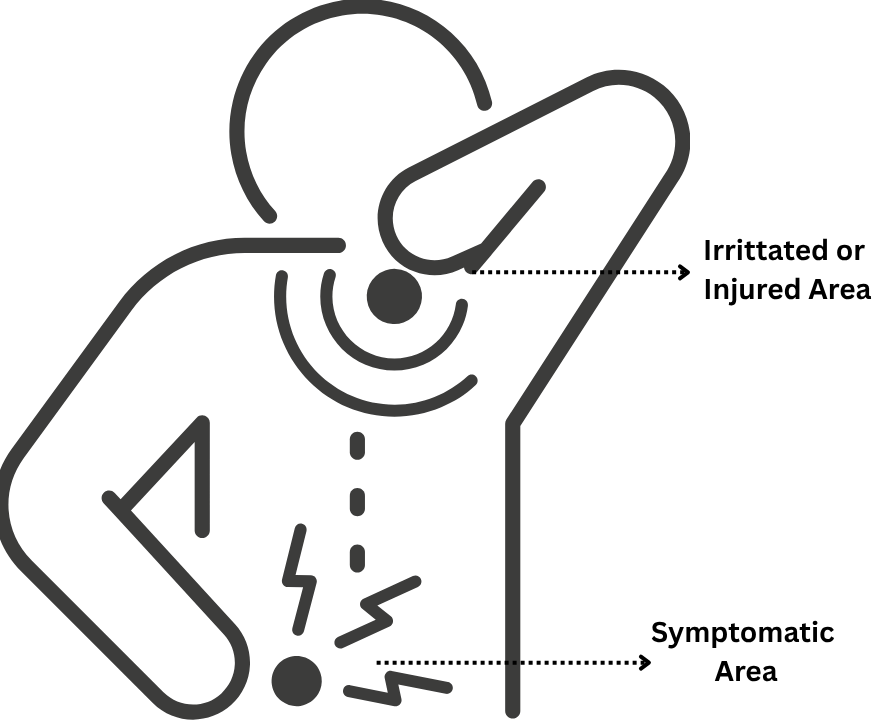
Referred pain can also show up as muscle pain when the organs in that same area of the body are irritated or inflamed. For example, low back pain when the kidneys are inflamed. Because of their location in the body, when the kidneys become even slightly inflamed, they begin to push on those same pain receptors as muscular low back pain is felt. In this scenario, no amount of tissue work, massage of the musculature, ligaments, and fascia is going to make a significant difference. Organ, or visceral massage, or lymphatic drainage is necessary to address the true agitator, the overworked kidneys. In many cases, trigger point therapy can bring quick, long lasting relief for referred pain symptoms. In more severe cases, blood tests and MRI’s may be needed to learn exactly what is going on inside the body.
What your Nervous System has to do with Pain
The Nervous System is broken down into two distinct categories: the Central Nervous System (CNS) and the Peripheral Nervous System (PNS).
The CNS is comprised of the brain and spinal cord. The brain is in charge of receiving sensory information, processing it, and coordinating appropriate motor responses, while also handling visual, auditory, and speech. The spinal cord houses the cervical, thoracic, lumbar, and sacral segments of the anterior and posterior nerve roots.
The PNS includes the Somatic Nervous System which controls voluntary muscle movements. It also includes the Autonomic Nervous System, which is comprised of the Sympathetic Nervous System, which drives the fight or flight response; and the Parasympathetic Nervous System which controls involuntary functions, like breathing, heart rate, and healing.


In short, the Nervous System has everything to do with pain. Whenever there is pain in the body of any kind, from mild to severe, physical or emotional, your nervous system is playing a massive role. Your nervous system is what is interpreting that stressor and relaying it through all the appropriate channels to best convey that information to you. Whether that be a headache from dehydration, shortness of breath from heartbreak, or disrupted sleep patterns from work stress, your nervous system is the one taking the first and longest lasting hit from the cause. Many massage modalities, from a gentle swedish to comfort the body, to myofascial release to unlock holding patterns in the tissue, to biodynamic cranial sacral therapy that directly helps to reset the CNS can help one feel better in their body and mind, easing tension and stress and allowing the Nervous System to function better.
When to seek treatment and what to tell your therapist
So at what point do we know it’s time to make an appointment? Whether it be for a Chiropractic adjustment, massage session, or doctor’s appointment, that timeline varies for everyone.
At times when it may be a little more ambiguous showing up like the infamous tech neck or low back pain, starting low and slow is generally the best route. Meaning start with things lower on the invasive spectrum. Things like stretching, hydration, and heating pads are great in-the-moment go-to’s. Just remember, for as amazing a tool heating pads are, just make sure they’re a moist heating pad, one that will add moisture to the area, rather than dehydrating the tissue. A wet washcloth run under hot tap water works great, though you can find the specific heating pads online. Next would be to give us a call or click! The modalities offered at Psoas are wide ranging, from Somatic Breathwork, Lomi Lomi, and Thai massage to Sports Therapy, Cupping, and Deep Tissue to our alphabet soup modalities NKT, PDTR, and ART, there is quite literally a modality for everyone and every ailment.
When wondering what you should share with your therapist, there is no such thing as TMI! We want to know it all, and can often see links or connections to what you’re experiencing and how it’s showing up in the body that while living in the pained body is easy to overlook. Knowing all the details, big and small, can help lead us to a better treatment plan for you. We want to know when the pain came on, but it’s also extremely helpful to know if you play a sport or hit the gym. We want to know which workouts you do and how often. We want to know about your work, your home life as far as responsibilities like caring for young children or older adults. We want to know of any physical ailments you’ve had over the years, and if there was ever a surgery, even if it was on a completely different part of the body. The reason for this is simple, our bodies are fully connected. Remember that childhood skeleton song that says “the knee bone’s connected to the thigh bone, the thigh bone’s connected to the hip bone..” and so on? It’s a fantastic example, or reminder, of just how truly connected our bodies are. Perhaps you’re coming in for an ankle issue. Learning you have had hip issues in the past, even years and years ago, gives us more information on the best way to approach your condition. It gives us the history that may have led to this current sprained ankle, we want to address the possible low back or glute weakness that led to the rolled ankle in the first place. We want to bring you pain relief and prevent future injuries. So please, give us your tell all!
In Closing
Our bodies today, right now, are a log of information going all the way back to childhood. From silly missteps to car accidents, from workouts to work life, it’s true, the body remembers. And our bodies are constantly feeding us information about the state of its being.
Sometimes, we don’t fully grasp the importance of what our body is trying to tell us and other times we simply don’t listen. That twinge we feel in our back after a long day at the computer that we ignore because we have to finish out the day, there’s errands to run or a workout to be squeezed in for mental health. That nudge from our body saying, “Hey, maybe take it easy today, I’m not feeling great, I need some downtime” we push past that nudge because life and responsibilities demand it. The pain seemingly “goes away” and we think, see, it wasn’t that serious and don’t give it a second thought. Until one day a normal chore like folding laundry or picking something up off the floor sends us into excruciating pain. Thinking we’ve “thrown our back out” or “this is just what aging is”, we book a massage or chiropractic appointment and figure that one session will fix us. Or at the very least get us back to being able to do all the things that life requires of us. We treat this acute pain with acute care, a day or 2 of taking it easy, stretching, probably a heating pad, some anti-inflammatories, and a massage. Then we’re right back to spending 8 hours a day at a desk without stretch breaks, or right back to bending over at the waist and not at the knees to pick up the kids' toys from the floor. Maybe we go right back to heavy lifting in the gym or slack off our water intake and postpone that massage appointment. Until the next time comes and we “throw out our back again”. Only this time it’s serious, every movement hurts, nothing brings relief, and now the pain is beginning to radiate into other parts of the body. Now we’re making Orthopedic appointments, getting MRI’s, and learning it’s become a herniated disc issue. All because when our body first said, “Hey”, we ignored it and pushed through. So our body had to get loud, had to force you to stop and pay attention. If only we’d noticed the signs and understood the language our body was using in the first place.
Thankfully you already happen to know some pretty amazing experts at interpreting what the body is trying to tell you. The therapists at Psoas would all be delighted to help you become more attuned with your body’s communication system! Reach out and let's work together to break down your body’s distinct language and either prevent Acute pain from becoming Chronic pain, or create a treatment plan for your existing chronic pain conditions.
Comments